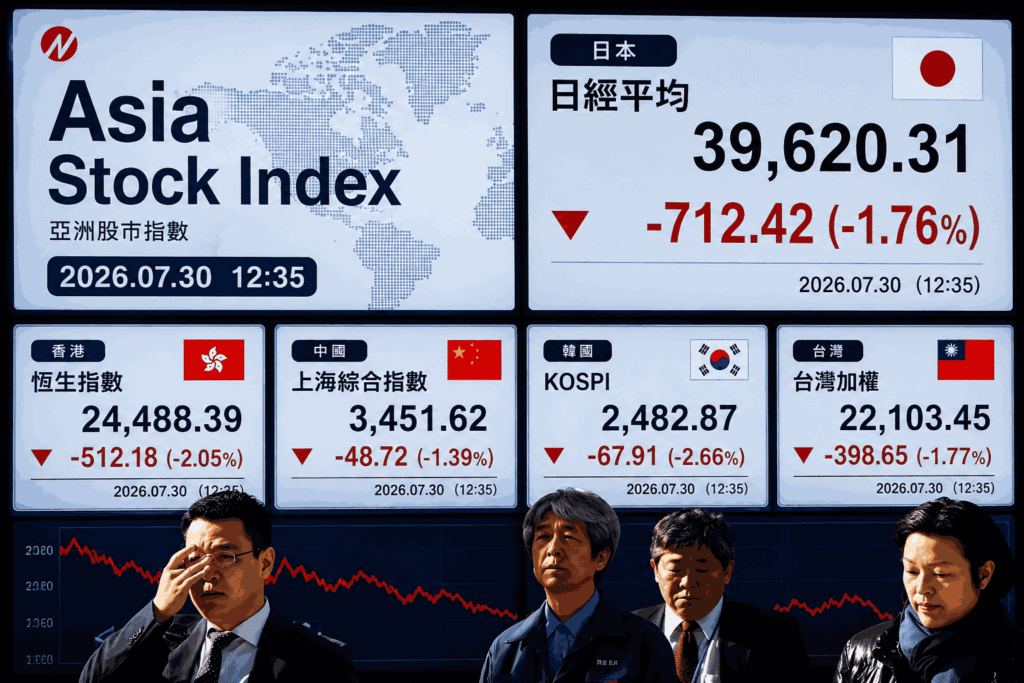
Asia Stocks Fall as Investor Caution Returns
Asian stock markets ended mostly lower on Wednesday as investors weighed corporate earnings, economic data, and global trade concerns. South Korea’s KOSPI index initially climbed following stronger-than-expected earnings from Samsung Electronics, But later, they changed their decision and lost about 5% of their gains, showing that investors are still being careful. The mixed trading shows that worries about the economy are still bigger than good news from companies in many Asian markets.
KOSPI Gives Up Early Gains
South Korea’s benchmark KOSPI Index opened higher after Samsung Electronics reported solid quarterly financial results that exceeded many analysts’ expectations.
Investors initially welcomed:
- Higher-than-expected profits
- Strong semiconductor demand
- Improved earnings outlook
- Better performance in AI-related chip business
However, selling pressure increased later in the trading session as investors locked in profits and shifted their attention to broader economic risks.
Samsung’s Strong Results

Samsung Electronics stayed one of the main companies influencing the market.
The company saw better earnings because of:
1- More people wanting high–tech memory chips
2- Sales of semiconductors related to AI
3- A steady performance in its smartphone business
4- Better profits from its operations
Even though Samsung’s results gave some early hope, it didn’t help the overall market much during the day.
Why Did Asian Stocks Fall?
Several factors contributed to weaker market sentiment.
1. Global Interest Rate Uncertainty
Investors continue monitoring major central banks, especially the U.S. Federal Reserve, for signals regarding future interest rate decisions.
Higher interest rates generally reduce investor appetite for riskier assets such as equities.
2. Economic Growth Concerns
Many investors remain cautious about:
- Slowing global demand
- Weak manufacturing activity
- Trade uncertainty
- Inflation risks
These concerns continue affecting stock markets across Asia.
3. Profit-Taking
After recent market gains, many investors chose to lock in profits, creating additional selling pressure.
Regional Market Performance
Across Asia, trading was mixed.
South Korea
- KOSPI erased earlier gains despite Samsung’s strong earnings.
Japan
Japanese stocks traded cautiously as investors monitored corporate earnings and currency movements.
China
Chinese markets remained under pressure amid concerns about economic recovery and property sector challenges.
Hong Kong
Technology and financial shares experienced mixed performance as investors assessed company earnings.
Technology Sector in Focus
Technology companies remained at the center of investor attention.
Artificial intelligence continues driving demand for advanced semiconductors, benefiting major chip manufacturers across Asia.
Despite strong earnings from leading technology companies, investors remain cautious because overall market valuations have increased significantly during recent months.
What Investors Are Watching
Market participants are closely following several developments:
- Upcoming U.S. economic data
- Federal Reserve policy decisions
- Inflation reports
- Corporate earnings season
- Semiconductor demand
- China’s economic recovery
- Global trade developments
These factors are expected to influence Asian markets over the coming weeks.
Impact on Global Markets

Asian market performance often influences investor sentiment worldwide.
Weakness in Asian equities may affect:
- European markets
- U.S. stock futures
- Technology stocks
- Semiconductor companies
- Commodity prices
Investors are also watching currency markets, particularly movements in the U.S. dollar and major Asian currencies.
Investment Outlook
Although short-term volatility remains elevated, many analysts believe long-term opportunities continue to exist in sectors such as:
- Artificial Intelligence
- Semiconductor manufacturing
- Renewable energy
- Financial services
- Healthcare technology
However, investors are encouraged to remain diversified and monitor economic developments before making investment decisions.
Conclusion
Asian stock markets fell as worried investors focused more on big worries than on good company results. Even though Samsung Electronics did better than expected in its financial report, overall fears about the global economy, interest rates, and how high stock prices are made investors less confident.
The drop in South Korea’s KOSPI shows that good earnings alone might not be enough to keep the market going if investors are still worried about bigger economic issues.
Future reports on the economy and decisions by central banks will probably decide where Asian markets go next.
