TikTok continues to be one of the most powerful platforms for creators who want to build an audience, grow a personal brand, promote a business, or turn content creation into a long-term opportunity. However, simply uploading videos is not enough to build consistent growth.
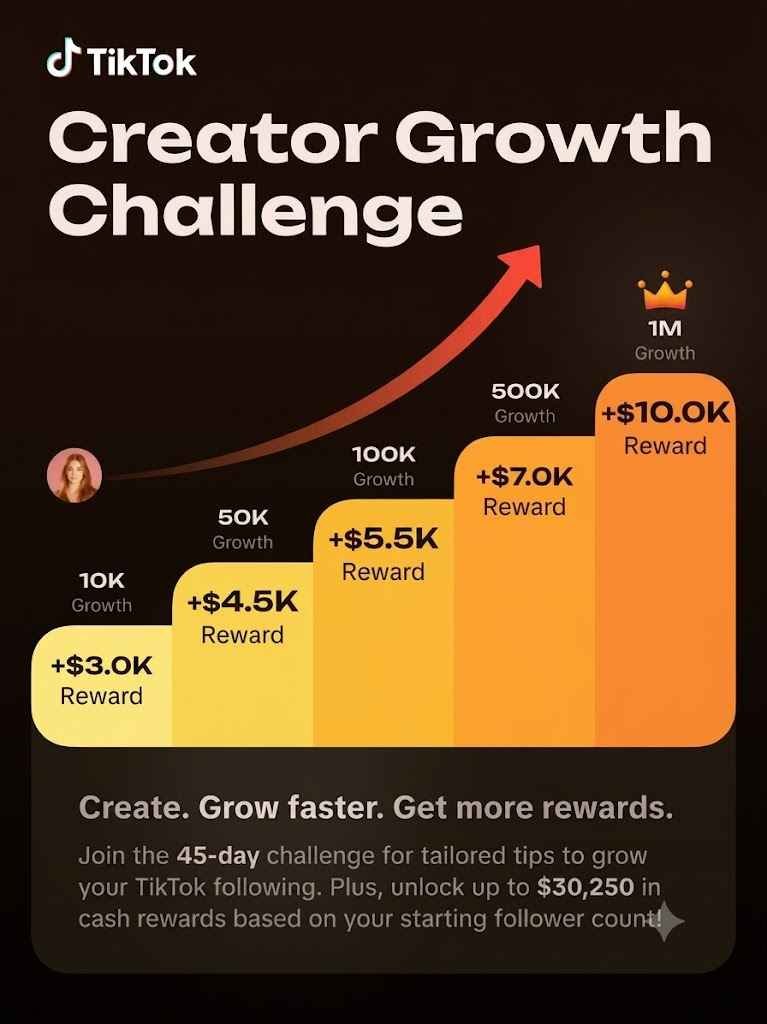
The TikTok Creator Growth Challenge Program 2026 is a structured 30-day strategy designed to help creators improve their content, increase audience engagement, understand analytics, and develop a repeatable growth system.
This challenge does not constitute an official TikTok initiative nor does it assure viral views. Rather, it serves as a practical creator challenge designed to help structure your content strategy for the year 2026.
What Is the TikTok Viral Growth Challenge Program 2026?
The TikTok Viral Growth Challenge is a comprehensive 30-day strategy aimed at enhancing content creation and growth through regular posting, boosting video retention, fostering engagement, and analyzing performance metrics.
Rather than relying on a single viral video to elevate an account instantly, this challenge emphasizes the importance of generating numerous growth opportunities.
Throughout the 30-day period, creators are encouraged to try out various hooks, video styles, subjects, captions, audio tracks, and posting techniques.
The primary goal is not merely to increase follower count, but to cultivate an audience that consistently views, engages with, and returns to your content.
Why TikTok Growth Requires a Strategy in 2026
TikTok is highly competitive, with creators publishing content across almost every niche. A video needs to capture attention quickly and provide a reason for viewers to continue watching.
Several factors can influence the performance of a video, including:
- Viewer retention
- Watch time
- Replays
- Likes and comments
- Shares
- Content relevance
- Audience interest
- Video consistency
- Strong opening hooks
This means creators should focus on creating content that people actually want to watch rather than relying only on hashtags or trending sounds.
The 30-Day TikTok Growth Challenge
Days 1–3: Choose Your Niche
Start by clearly defining your content niche.
Examples include:
- Finance
- Technology
- AI
- Fitness
- Motivation
- Gaming
- Education
- Entertainment
- Pets
- Fashion
- Food
- Travel
A focused niche makes it easier for viewers to understand what your account offers.
During the first three days, research successful creators in your niche and identify common video formats, topics, hooks, and presentation styles.
Do not simply copy their videos. Instead, identify patterns that you can adapt into your own original content.
Days 4–7: Create Strong Hooks
The first few seconds of a TikTok video are extremely important.
Instead of starting with a long introduction, immediately give viewers a reason to continue watching.
Examples of hooks include:
“Almost everyone makes this mistake…”
“Here are three things you need to know…”
“Nobody tells you this about…”
“Watch until the end because the last one is surprising.”
“If you are trying to grow on TikTok, stop doing this.”
Your opening should match the actual content of the video. Avoid misleading viewers because poor satisfaction can hurt long-term audience growth.
Days 8–10: Improve Video Retention
Getting views is only one part of TikTok growth. Keeping viewers watching is equally important.
Try to remove unnecessary pauses and introductions from your videos.
Use:
- Fast visual changes
- Captions
- Short sentences
- Pattern changes
- Relevant B-roll
- On-screen text
- Storytelling
- Questions
- Curiosity-driven transitions
For example, instead of explaining five tips in a slow format, create a fast-paced list where each tip delivers useful information.
The goal should be to make every second of the video useful or entertaining.
Days 11–15: Test Different Content Formats
Do not depend on one type of video.
During this stage, experiment with several formats such as:
Educational videos: Teach viewers something useful.
List videos: Present several tips, tools, facts, or ideas.
Storytelling: Share a story with a clear beginning, middle, and ending.
Reaction content: Respond to relevant trends or discussions.
Before-and-after content: Show a transformation or improvement.
Tutorials: Demonstrate how to accomplish a specific task.
Testing different formats helps you discover what your audience responds to most strongly.
Days 16–20: Analyze Your TikTok Analytics
At this stage, review the performance of your previous videos.
Look for patterns in:
- Views
- Average watch time
- Retention
- Shares
- Comments
- Likes
- Follower growth
- Traffic sources
Do not judge your account based on one video.
Instead, compare multiple posts and identify which topics and formats consistently perform better.
For example, if educational videos regularly generate more watch time and shares than random trend videos, you may want to increase educational content.
Days 21–25: Double Down on Winning Content
Once you identify your strongest content, create more variations around those ideas.
If one video performs well, do not simply repost the same video.
Create related content.
For example:
Video 1: 5 TikTok growth mistakes
Video 2: 5 TikTok growth tips
Video 3: Why your TikTok videos are not getting views
Video 4: How to improve TikTok retention
Video 5: A 7-day TikTok posting strategy
This creates a content series and gives viewers more reasons to follow your account.
Days 26–28: Increase Audience Engagement
TikTok growth is not only about publishing content. Building relationships with viewers can also strengthen your community.
Encourage genuine interaction by asking relevant questions.
For example:
“Which strategy would you try first?”
“What topic should I cover next?”
“Have you experienced this problem?”
You can also respond to useful comments with new videos when appropriate.
The goal is to turn passive viewers into active members of your audience.
Days 29–30: Review Your Results
At the end of the challenge, compare your account’s performance with where you started.
Record:
- Total views
- New followers
- Average views per video
- Best-performing video
- Highest-retention video
- Most-shared video
- Best-performing topic
- Best-performing format
This information can become the foundation of your next 30-day content plan.
How Often Should You Post?
There is no single posting frequency that guarantees viral results.
Instead of posting a large number of low-quality videos, focus on producing content that you can maintain consistently.
A practical challenge could involve one or two quality videos per day, depending on your available time and ability to maintain quality.
Consistency matters because it gives you more opportunities to test ideas and learn what your audience likes.
Use Trends Strategically
Trends can help creators discover new audiences, but blindly following every trend is not an effective strategy.
Choose trends that naturally fit your niche.
For example, a finance creator could adapt a popular format to explain money-saving tips, while a technology creator could use the same format to explain AI tools.
The trend should support your content rather than become the entire content strategy.
Focus on Original Value
One of the biggest mistakes creators can make is producing content that feels repetitive or copied.
Instead, add your own:
- Experience
- Opinion
- Explanation
- Story
- Editing style
- Presentation
- Research
- Personality
Two creators can discuss the same topic while producing completely different videos because their presentation and perspective are unique.
Create a Repeatable Content System
The biggest benefit of a 30-day challenge is not reaching a specific follower number.
The real goal is developing a system that you can continue after the challenge ends.
A simple system can look like this:
Research → Create Hook → Record → Edit → Publish → Analyze → Improve → Repeat
After 30 days, you should have enough performance data to understand which topics and formats deserve more attention.
Common TikTok Growth Mistakes
Avoid relying entirely on hashtags to make videos viral.
Other common mistakes include:
- Weak introductions
- Long unnecessary intros
- Inconsistent posting
- Copying other creators
- Ignoring analytics
- Poor audio quality
- Using irrelevant trends
- Making videos without a clear purpose
- Deleting videos too quickly because they start slowly
- Focusing only on follower count
Growth usually comes from continuous testing and improvement rather than one secret trick.
Final Thoughts
The TikTok Viral Growth Challenge Program 2026 provides a structured way to improve your content strategy over 30 days.
The essential elements include focusing on compelling hooks, maintaining viewer retention, providing valuable content, ensuring consistent publishing, engaging with the audience, and analyzing performance.
While there is no surefire method to make every video go viral, creators who regularly experiment with ideas, analyze their outcomes, and refine their content can enhance their chances for sustainable growth.
Begin by selecting a specific niche, publish regularly, learn from each video, and leverage your most successful ideas as the basis for your subsequent content cycle.
Disclaimer: Features of TikTok, its recommendation algorithms, analytics, and platform policies are subject to change over time. Results may differ based on account, audience, niche, content quality, and various other factors. No growth strategy can assure a particular number of views or followers.
